BQ Calculators

Muscle to Bone Ratio and Goals

How much muscle does this person carry for their frame, and what body mass does a chosen muscle and fat goal lead to?

What you enter

  • Part 1, from the 5-Way: body mass, muscle, adipose and bone mass (kg or lb). One button fills these from the 5-Way report.
  • The muscle model (UT, MT-BQ or MT-ISAK), a lean goal (a muscle to bone ratio, a fat free mass, or hold) and an adipose goal (% or mass).
  • Part 2, body fat: body mass and % fat from any method (skinfold equations, DXA, BOD POD, underwater weighing, BIA or BIS, a multi compartment model or other), with a fat free mass goal and a fat goal.
  • Part 3, a combined plan: Part 1's lean goal with Part 2's fat goal.
  • Optional: a comparison group (ARGOREF adults aged 20 to 30, or the Montreal 1976 Olympians) and your measurement error (TEM).
What you get

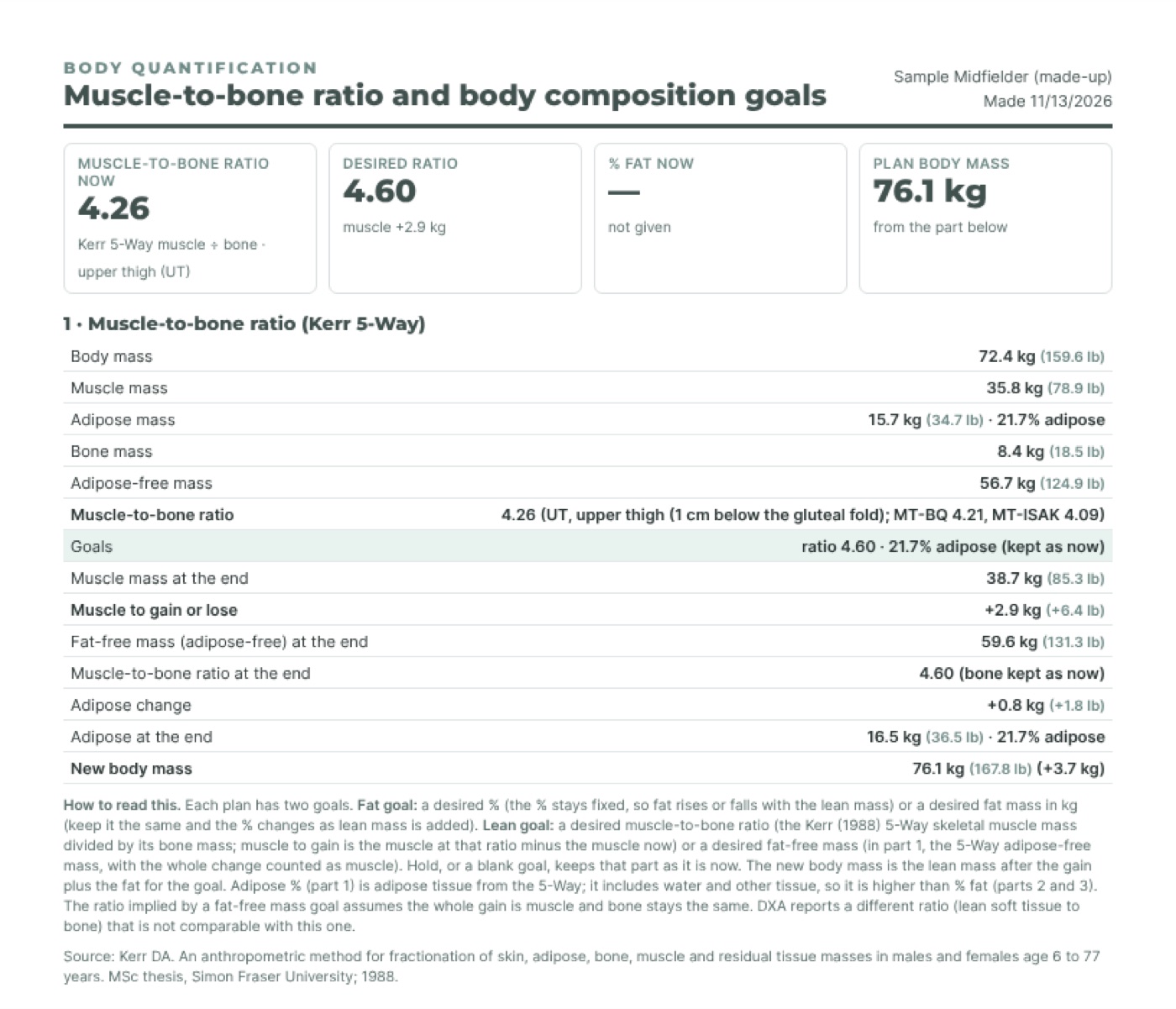
  • Top boxes: the ratio now, the desired ratio (and the muscle to gain), % fat now and the plan body mass.
  • A table for each part, from the masses now to the muscle to gain or lose, the ratio at the end, the adipose change and the new body mass.
  • A "how to read this" note.
  • Print, PDF and save to My data.

A sample report

A sample Muscle to Bone Ratio and Goals report for a made up soccer midfielder: ratio 4.26 now, goal 4.60, muscle to gain and the new body mass

A real Muscle to Bone Ratio and Goals report, made for "Sample Midfielder", a made up person: ratio 4.26 now and a goal of 4.60. Not a real athlete.

Method

  • The ratio is Kerr's (1988) 5-Way muscle mass divided by bone mass.
  • A % fat goal: new body mass = lean mass ÷ (1 − desired %).
  • A fat mass goal: new body mass = lean mass + desired fat mass.
  • Comparison groups: ARGOREF (Holway 2005) and the Montreal 1976 Olympians (Carter 1982, Appendix C: 309 men and 148 women), with the Kerr 5-Way worked out by BQ from the published individual data.

Limits

  • A plan is a target to discuss, not a prediction of how fast it can be reached.
  • A fat free mass goal assumes the whole gain is muscle and bone stays the same.
  • Adipose % (Part 1) is higher than % fat (Parts 2 and 3), because adipose tissue includes water and other tissue.
  • A DXA lean to bone ratio is a different measure and can't be compared with this one.

Results are estimates, not medical advice or a diagnosis.

References

  1. Kerr DA. An anthropometric method for fractionation of skin, adipose, bone, muscle and residual tissue masses, in males and females age 6 to 77 years [MSc thesis]. Burnaby, BC: Simon Fraser University; 1988.
  2. Holway F. Datos de referencia antropométricos … Tablas "Argo-Ref". 2005 (ARGOREF).
  3. Carter JEL, ed. Physical Structure of Olympic Athletes, Part I. Medicine and Sport 16. Karger; 1982 (Appendix C).

Version live today: Muscle to Bone Ratio and Goals 1.4.0-preview, in the BQ Calculators v0.14.92.

This calculator is part of the BQ Calculators, for members. Enter the measurements once and run every calculator.

Other calculators: 5-Way Fractionation · Youth Growth · Wrestling Minimum Weight · Full Level 2 Report · TEM: my measurement error