BQ Calculators

Full Level 2 Report

For an ISAK Level 2 full profile, how does each of the 43 measurements compare with the Phantom, with the full 5-Way report included?

What you enter

  • Needed: sex, stature and the skinfold caliper you used. It runs with the sites you have.
  • The 5-Way sites, for Part 1 (see the 5-Way page).
  • The 18 Level 2 sites:
  • Skinfolds (mm): biceps and iliac crest.
  • Girths (cm): neck, wrist and ankle.
  • Lengths and heights (cm): acromiale-radiale, radiale-stylion, midstylion-dactylion, iliospinale height, trochanterion height, trochanterion-tibiale laterale, tibiale laterale height, foot length and tibiale mediale-sphyrion tibiale.
  • Breadths and depths (cm): A-P abdominal depth, bistyloid and bimalleolar.
What you get

  • Part 1: the full 5-Way report, unchanged.
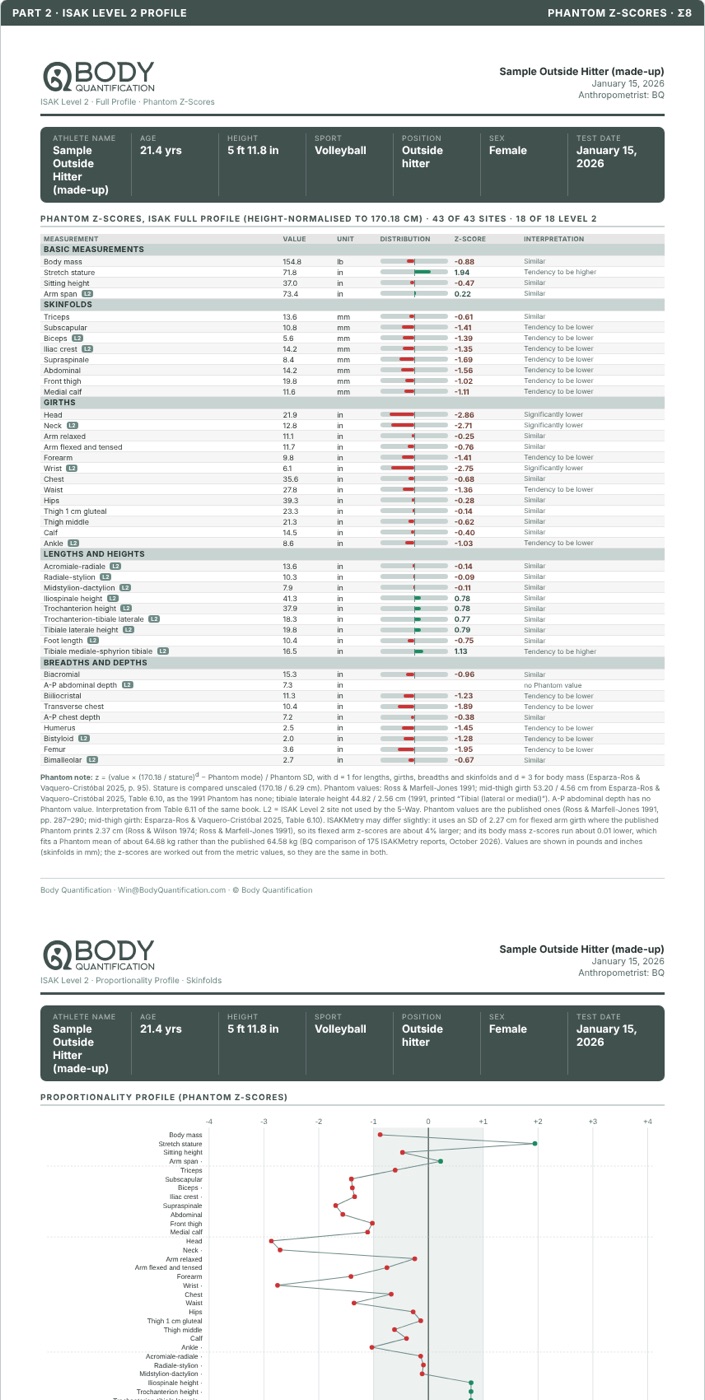
  • Part 2: Phantom z-scores for all 43 full profile sites, each with a plain word (similar, tendency to be higher or lower, significantly higher or lower).
  • A proportionality profile chart of the z-scores from −4 to +4.
  • The sum of 8 skinfolds, proportion indices and segment lengths.

A sample report

Part 2 of a sample Full Level 2 report for a made up volleyball outside hitter: Phantom z-scores for all 43 sites and the proportionality profile chart

Part 2 of a real Full Level 2 report, made for "Sample Outside Hitter", a made up person with all 43 sites. Not a real athlete.

Method

  • Phantom z-score: z = (value × (170.18 / stature)d − Phantom mean) / Phantom SD, with d = 1 for lengths, girths, breadths and skinfolds and d = 3 for body mass (Esparza-Ros and Vaquero-Cristóbal 2025, p. 95).
  • Phantom values: Ross and Marfell-Jones 1991, with the mid thigh value from Esparza-Ros and Vaquero-Cristóbal 2025 (Table 6.10). Tibiale laterale height uses 44.82 / 2.56 cm (1991).
  • Readings far from the Phantom (beyond ±4 z) are flagged "check this reading", never rejected.
  • Part 1 uses the 5-Way method and its references.

Limits

  • A-P abdominal depth has no Phantom value, so it is shown as a value only.
  • Part 1 has the same limits as the 5-Way.

Results are estimates, not medical advice or a diagnosis.

References

  1. Ross WD, Wilson NC. A stratagem for proportional growth assessment. Acta Paediatr Belg. 1974;28(Suppl):169–182.
  2. Ross WD, Marfell-Jones MJ. Kinanthropometry. In: MacDougall JD, Wenger HA, Green HJ, eds. Physiological Testing of the High-Performance Athlete. 2nd ed. Human Kinetics; 1991 (Phantom, pp. 287–290; derived variables, p. 248).
  3. Esparza-Ros F, Vaquero-Cristóbal R. Anthropometry: Fundamentals of Application and Interpretation. Springer; 2025 (section 6.3.1, pp. 83–89; Tables 6.1, 6.2, 6.3, 6.6, 6.7 and 6.10).
  4. Part 1 carries the references of the 5-Way.

Version live today: Full Level 2 0.6.2, in the BQ Calculators v0.14.92.

This calculator is part of the BQ Calculators, for members. Enter the measurements once and run every calculator.

Other calculators: 5-Way Fractionation · Youth Growth · Wrestling Minimum Weight · Muscle to Bone Ratio and Goals · TEM: my measurement error